Water voles, also known as water rats or simply voles, are small semi-aquatic rodents native to Europe and parts of Asia. They inhabit a variety of wetland habitats, including rivers, streams, ponds, marshes, and ditches, where they are well adapted for both terrestrial and aquatic life. Water voles play important ecological roles as herbivores, feeding primarily on grasses, sedges, and other aquatic vegetation, and serving as prey for a variety of predators.
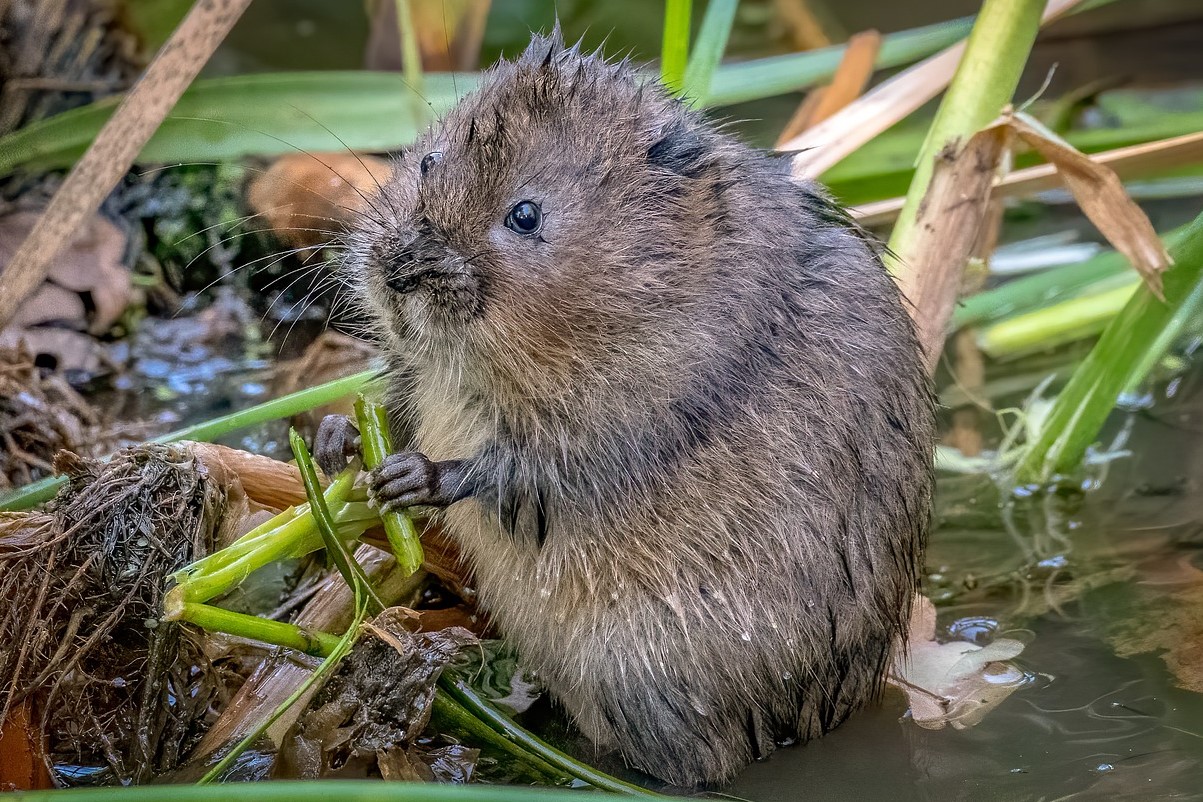
One of the distinctive features of water voles is their stout, round bodies, which are covered in dense fur ranging from brown to reddish-brown in color. They have relatively short legs and tails compared to other rodents, which are well suited for navigating their aquatic habitats. Their fur is waterproof, allowing them to stay dry and warm while swimming and diving in water bodies, and their partially webbed hind feet provide propulsion while swimming.
Water voles are skilled burrowers, constructing intricate tunnel systems along the banks of water bodies. These burrows serve as nesting sites, refuges from predators, and storage areas for food. Water voles are primarily active during the day, foraging for vegetation near water sources and storing food in their burrows for later consumption. Despite their elusive nature, water voles are important indicators of wetland health and biodiversity and are subject to conservation efforts in many regions due to habitat loss, pollution, and predation by introduced species such as the American mink.